
There is a pattern in construction software that nobody talks about. Every platform ships the same base product. They assume every workflow is identical. They build one scope tool, one bid board, one procurement module, and they hand it to every customer with a straight face.
It does not work. And everyone in the field knows it.
The one-size-fits-all trap
A GC running healthcare fit-outs operates in a completely different world than one doing ground-up commercial. The scoping requirements are different. The compliance layers are different. The trades involved, the spec formats, the submittal workflows. None of it overlaps cleanly.
A subcontractor doing electrical has different needs than a concrete contractor. Their scope packages look nothing alike. Their line items, their units of measure, their cost structures. All different.
Yet every construction software company builds one template and tells you to make it work. Customize it yourself. Drag some fields around. Add a dropdown. Good luck.
Why does this keep happening?
Because it is easier to build one product than to build something that actually adapts. Most companies start with a generic data model, layer a UI on top, and call it a platform. They do not invest the time to understand how construction actually functions at the trade level, at the project-type level, at the regional level.
The result is software that looks fine in a demo and falls apart on a real project. You spend hours reformatting scope packages that the tool was supposed to generate for you. You manually tag trades because the system cannot tell the difference between mechanical and plumbing line items. You copy and paste from specs into a template that was designed for a different project type entirely.
We built scope generation differently
When we started building Orcera, we made a decision early on. Every instance would be fully customizable. Not in the "drag a field to a new position" sense. In the "the system actually understands your specific workflow" sense.
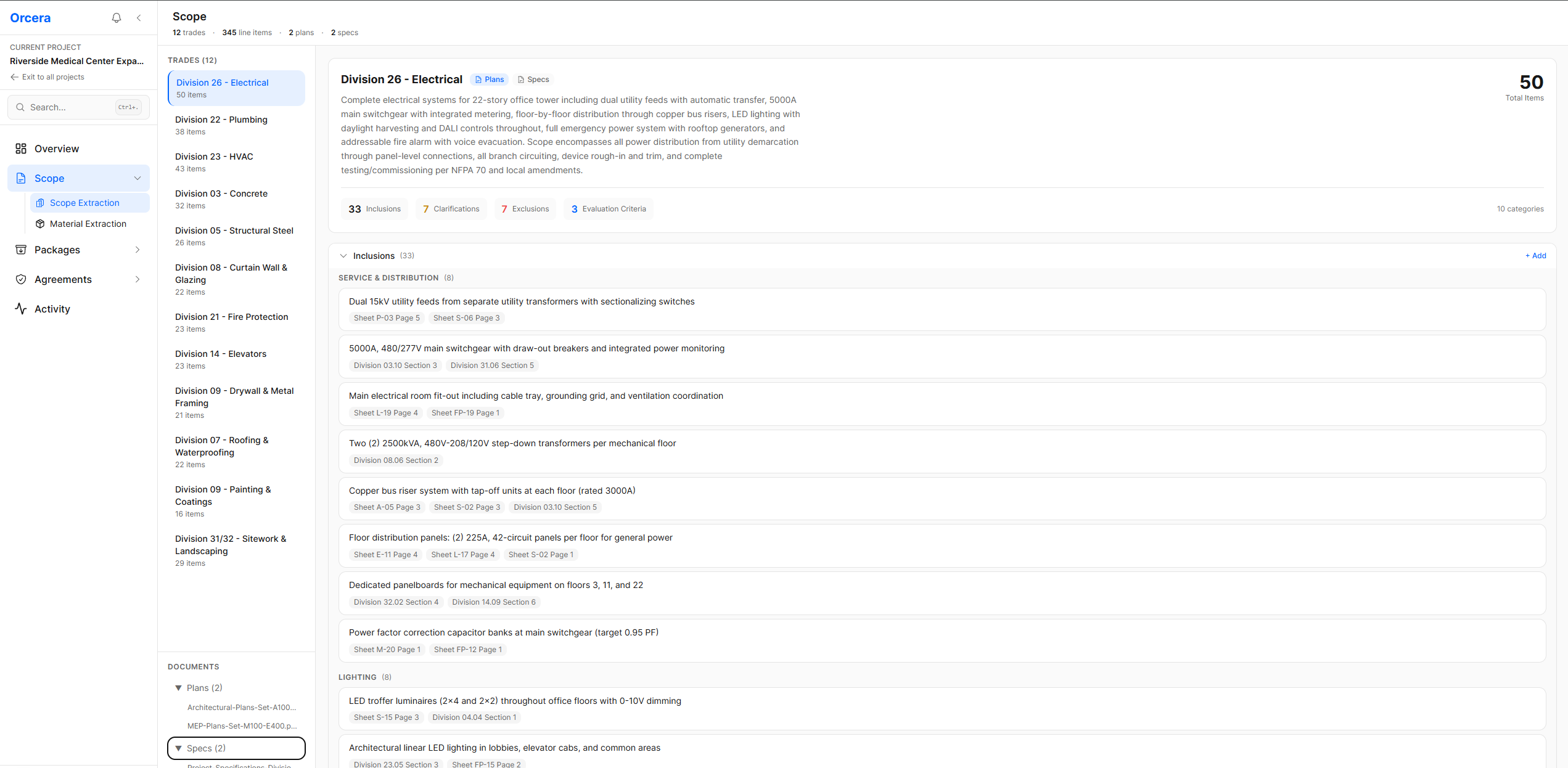
Orcy, our proprietary agent, reads your plans and specs. It does not match keywords. It does not run OCR and hope for the best. It understands what it is reading. It knows the difference between a mechanical spec section and an electrical one. It can parse a drawing set and extract scope items that are specific to your project, not pulled from a generic database.
What that looks like in practice
You upload your plans and specs. Orcy reads them. It generates scope packages that are project-specific, trade-classified, and source-traced back to the exact page and section of the document where each item originated.
Not generic templates you have to manually fix. Actual scope packages that reflect what is in your documents.
If you are a GC doing healthcare work, the scope packages reflect healthcare-specific requirements. If you are doing retail, they reflect retail. The system adapts because it was built to adapt, not because you spent three hours configuring dropdowns.
The bar is too low
Construction teams have been trained to accept mediocre tools. They expect to spend time fighting the software. They budget hours for manual cleanup on top of whatever the platform generates.
That is not a technology problem. It is a design problem. If you build scope generation that actually reads and understands project documents, you do not need the manual cleanup step. The output is usable from the start.
We think the industry deserves better than templates. Construction is dynamic, project-specific, and complex. The tools should be too.